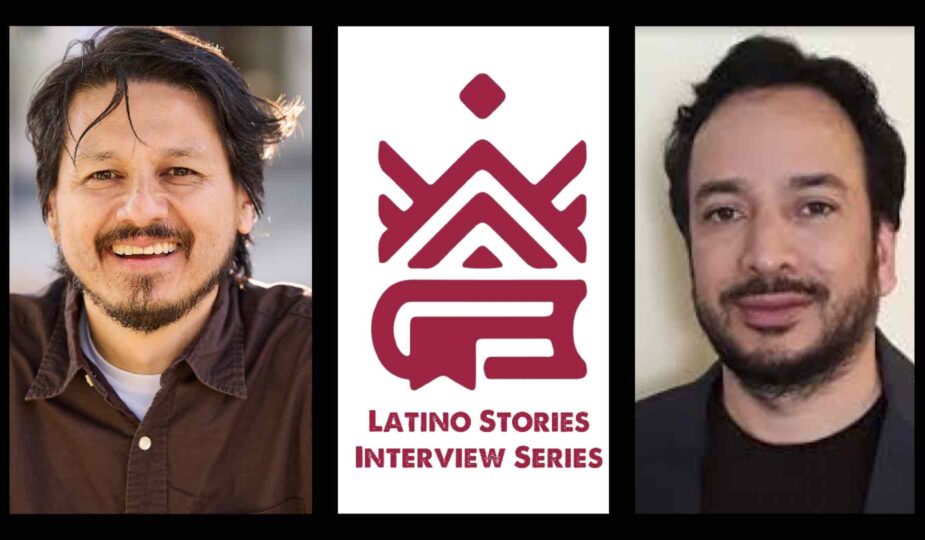
Azul After Exile: León Salvatierra Interviews William Archila
This interview with William Archila is part of the Latino Stories series featuring conversations with Latinx authors. The questions that follow grew out of Archila’s recent visit to the CHI 158 course, Central American Poetry in the United States, which Salvatierra teaches at UC Davis in the Chicana/o/x Studies Department. Students read his book S is For, and Archila joined the class for a wide-ranging conversation about migration, poetic craft, and the literary traditions that shape Central American writing in the United States.
Salvatierra: In S is For, there is a poem that meditates on the color blue in striking ways: from references to Sonny Rollins’ Colossus to Rubén Darío’s Azul. When I read that poem, I began thinking about how the color azul appears throughout Central American poetry more broadly. In recent years I’ve noticed its presence not only in your work but also in books such as Adela Najarro’s Variations in Blue and in other Central American poets writing in the United States. As someone who wrote my doctoral dissertation on Darío’s Azul, I sometimes feel that Darío wasn’t only writing a book of poems but almost the poetic DNA of what would come after. Do you see the color azul functioning as a kind of symbolic inheritance in Central American poetry, and how did you arrive at its use in that poem?
Archila: That’s an amazing observation. Azul—not just as a color, but as a concept—is absolutely in our DNA as Central American poets, whether we are writing from the isthmus or from the diaspora in the United States. I remember when I was a young boy in El Salvador looking up at the sky. All I could see was blue, then the ocean reflected in the sky, the blue volcanoes, the blue flags, “even my school uniform was a blue guayabera.” That’s the landscape of Central America.
Ruben Dario is a figure that continues to loom over Spanish literature, impossible to ignore, and Azul is the foundation of Modernismo. When I was working on S is For, that deep-rooted inheritance felt necessary because of its symbolism and aesthetics; the color blue as the sky, the sea, infinity, and the aesthetic ideals of the poet. Regarding the poem you mentioned, “This field of weeds & wildflowers,” I arrived at using azul as a meditation because, as a child of the Salvadoran diaspora who left during the civil war in 1980, I am constantly trying to map the distance between my origins and my present. Azul is our inheritance as Central American poets in the US. It represents a longing for a romanticized, idealized past, yet it is also haunted by the violence that colors our history. It is the blue of the sky over the volcanoes, but also the bruising of the skin, the “small Vietnam” of a country torn apart.
The Sony Rollins reference allows me to create a sonic landscape that bridges jazz—which is about improvisation, loss, and resilience—with our literary history. It is about taking the high-modernist azul of Darío and making it tangible and audible, just as Rollins does with a saxophone. Bringing in a “Colossus” like Sonny Rollins alongside Rubén Darío made sense to me. It just clicked. I had a visceral reaction to it. I trusted my intuition, my imagination over my knowledge. In recent years, seeing poets like Adela Najarro and others navigating the “variations in blue” suggests that we are all trying to articulate a similar inheritance. We are taking that blue inheritance and presenting it in a new context here in the United States. In S is For, I wanted to evoke that blue that is at once the vastness of the Pacific, calm, serene, and peaceful, and at times, the cold, indifferent, but also sad blue of the US landscape I live in now. I might even add turning blue into a philosophy against invisibility and displacement.

Now retrieving an image set.
blink plus plan with monthly auto-renewal
$11.99 (as of October 16, 2026 03:44 GMT -04:00 – More infoProduct prices and availability are accurate as of the date/time indicated and are subject to change. Any price and availability information displayed on [relevant Amazon Site(s), as applicable] at the time of purchase will apply to the purchase of this product.)
Now retrieving an image set.
Apple EarPods Headphones with USB-C Plug, Wired Ear Buds with Built-in Remote to Control Music, Phone Calls, and Volume
$19.00 (as of October 16, 2026 03:44 GMT -04:00 – More infoProduct prices and availability are accurate as of the date/time indicated and are subject to change. Any price and availability information displayed on [relevant Amazon Site(s), as applicable] at the time of purchase will apply to the purchase of this product.)
Now retrieving an image set.
Apple AirTag (2nd Generation): Tracker for Keychain, Wallet, and More; Locator with Sound; Simple One-Tap Setup with iPhone or iPad; Key Finder with up to 1.5X Precision Finding Range
$24.00 (as of October 16, 2026 03:44 GMT -04:00 – More infoProduct prices and availability are accurate as of the date/time indicated and are subject to change. Any price and availability information displayed on [relevant Amazon Site(s), as applicable] at the time of purchase will apply to the purchase of this product.)
Now retrieving an image set.
Apple AirPods Pro 3 Wireless Earbuds with Active Noise Cancellation | Live Translation, Heart Rate Sensing, Hearing Aid Feature, Bluetooth Headphones, Spatial Audio, USB-C Charging
$199.00 (as of October 16, 2026 03:44 GMT -04:00 – More infoProduct prices and availability are accurate as of the date/time indicated and are subject to change. Any price and availability information displayed on [relevant Amazon Site(s), as applicable] at the time of purchase will apply to the purchase of this product.)
Now retrieving an image set.
Amazon Fire TV Stick 4K Plus with AI-powered Fire TV Search, Wi-Fi 6, stream hundreds of thousands of movies and shows, free & live TV, find shows faster with Alexa+
$69.99 (as of October 16, 2026 03:44 GMT -04:00 – More infoProduct prices and availability are accurate as of the date/time indicated and are subject to change. Any price and availability information displayed on [relevant Amazon Site(s), as applicable] at the time of purchase will apply to the purchase of this product.)Salvatierra: You arrived in Los Angeles from El Salvador in 1980 when you were twelve years old, at a moment marked by violence and civil war in Central America. I came to Los Angeles from Nicaragua several years later under similar circumstances. How did that early experience of displacement shape your understanding of language and poetry? And looking back now, how do you think that migration continues to inform the emotional and imaginative terrain of your work?
Archila: My displacement didn’t just change my language. It forced me to construct a new language entirely—one capable of naming truths that the war had silenced. For instance, when I first arrived in Los Angeles, I literally went numb. Not only had I just escaped the war, but my parents had also split up, and in addition, there was also the immediate necessity of learning a new culture and tongue. All of this under the fear of being deported. This displacement caused a sense of shutting myself down and a lasting tension that eventually burst in 1992 when I visited El Salvador after the peace accords between the military-led government of El Salvador (backed by the United States) and the Farabundo Martí National Liberation Front (FMLN) were signed. When I came back to the States, I realized I had all these feelings of exile. I had returned from a war-torn country full of poverty, death, silence, illiteracy, and crime. I felt like a stranger in a strange land. That’s when I began to write and writing became a cathartic outlet, revealing a deep longing to reconnect with my roots, family, and the shared immigrant experience. What fascinated me most during this phase was the urge to document my thoughts, finding instant peace in watching them take shape on paper. Poetry opened a new world for me outside of time. It became the ideal vehicle for active remembering, which I view as a struggle against history. I believe the function of poetry is to provide an authentic voice for the human struggle. Poetry is not fiction, nor history. It is the imagination of human history.
On the continued influence of migration, I see it not as a past event but as a permanent state of exile that defines my creative terrain. The architecture of my work is driven by the language of grief and mourning for the Salvadoran diaspora—a persistent exploration of the loss of place, family, and self. It often reflects a third space of identity, where the speaker feels like a foreigner in both countries, a ghost split between present and past. In S is For, I use the voice of the refugee and the exile as a weapon against invisibility, navigating the modern migrant crisis through the lens of my own haunting past. Migration continues to inform my work by providing a terrain with no road map, where the act of writing is a necessary, spiritual effort to understand the ramifications of my initial displacement.
Salvatierra: Many Central American poets writing in the United States return, in different ways, to the idea of origin—sometimes through memory, sometimes through travel, and sometimes through the imagination. You have spoken elsewhere about returning to El Salvador years after leaving and about how it took several visits before the place began to feel like a form of home again. How has that process of returning—or attempting to return—shaped your understanding of origin and home in your poetry?
Archila: The process of returning to El Salvador transformed my understanding of origin from a fixed physical location into a landscape of memory that exists in my fragmented language. For example, when I first returned to my native country after the peace treaty in 1992, I realized I was a stranger in my own native land, and this solidified a sense of being “of a country & without a country.” I realized that home was neither here nor there, which forced me to build a sense of home within the country of poetry. Thus, my origin as homelessness and exile. Because my memories were fragmented, my return visits allowed me to piece together a “ceremony or commemoration for the dead” through my writing. The Art of Exile is an attempt to rebuild the homeland because the physical home I remember no longer exists.
In addition to reconstructing the past through memory, I also have struggled with language. In my returns, I felt disconnect and I could not find the rhythm of the place. I address this by reclaiming the Salvadoran dialect and memory, filling the silence of my exile with the voices of the dead who remained. My new book Canícula/Dog Days aims to revive and recapture that sound. My revisits have also brought about change. My understanding of origin has shifted from the nostalgic, war-torn childhood home to an acceptance of a new El Salvador, enabling me to write not just out of loss, but through the gravedigger’s archaeology of digging into the ground to find what remains. Ultimately, the process of returning taught me that home is a constant, uneasy negotiation between the memories of El Salvador and the realities of his life in Los Angeles.
Salvatierra: Your forthcoming bilingual selected poems, Canícula: Antología poética 2009–2013, translated into Spanish by Mario Zetino, gathers work from across your collections. In class you mentioned that you worked closely with Zetino during the translation process. What was that collaboration like, and what did you discover about your own poems when seeing them move into Spanish? Did the process change the way you think about the relationship between language, audience, and the life of a poem?
Archila: When I read from my first book The Art of Exile back in 2010, the most common question was, “When will this be available in Spanish?” I didn’t have an answer then, but the query always stayed with me. The lack of a Spanish version of my work has always haunted me because it felt like a barrier between my work and my Salvadorean and Spanish Speaking communities. Now, the time is finally right to translate these poems into Spanish. The current political climate was the final impetus to publishing this book of translated poems. Publishing this translation is a profound emotional act—bringing the story back to the voices that inspired it. The bilingual format expands the audience, allowing the poem to reach both the English-speaking literary world and the Salvadoran diaspora it depicts. It is also a necessary, defiant validation of our culture under attack. Reading a book of poems translated into Spanish during a time of increased hostility toward Spanish-speaking peoples is a significant cultural, emotional, and political act.
I spent a wonderful year working alongside Mario Zetino, Salvadorean poet, translator and Scholar. The process was a close dialogue via email, and the collaboration was a natural and deeply rewarding partnership. Working with Zetino was a turning point. He is not just a translator but also a peer whose poetic sensibility and Salvadoran roots allowed him to capture the gritty and beauty intertwined in the poetics of the diaspora. He ensured the somber hardness of the original English lines resonated authentically in Spanish.
The biggest lesson I took away is that translation is a two-fold journey. There is the technical side, and then there is the feeling: the literal translation and the ‘translation of the heart.’ It’s where the expert ear of a native poet steps in to ensure the soul of the work isn’t lost in the mechanics of the language. I also learned from translating these poems do not write what the author says but what the author means to say. From every decision regarding word choice, diction, line break, prosody, syntax is an attempt to convey what the author means.
After living fifteen years with the English versions of these poems in Canícula, they have become part of my own voice—almost to the point of merging. Yet, if I must choose my favorite poems, I would have to say the Spanish versions. Seeing the poems move into Spanish revealed a haunting quality—the realization that while I write in English, the ghosts of the Spanish language has always been present in my work. A second voice emerges. The process solidified my view that the poem as a living entity exists beyond its initial language.
Salvatierra: You’ve mentioned that earlier poems often grew directly from memory, while more recent poems rely increasingly on imagination as a generative force. How do you think about the relationship between memory and imagination in your writing? Do they function as separate sources for the poem, or do they eventually become part of the same creative process as a poem takes shape and is revised?
Archila: Memory and imagination are inseparable, and together they form an evolving process where the past is actively reconstructed into a new reality. I think this is because memories get fuzzy and more beautiful as you get older. It’s almost like the less you know the more beauty you can find. The initial impulse for my work often comes from the fragmented memories of my childhood in El Salvador and the trauma of the civil war, but memory is not just a recollection of the past, but an active, desperate attempt to construct a language of mourning and reconstruct a homeland that was lost.
While the impetus is memory, I am condemned to see and hear that which once was lost. That requires me to use my imagination to bridge those gaps. Because memory is fragmented, I use my imagination to fill in the gaps, transforming my raw experiences into poems. In S is For, this evolved into a reconstructed memorial where I am not just reproducing a memory but creating a fiction out of my own diaspora. A prime example is the “Northern Triangle Dissected” where I depart from mere recollection of the civil war and its exodus and instead constructs a mythic, often surreal, fictionalized landscape that addresses the trauma and displacement of the diaspora. There’s no creation without destruction. You cannot build a new world without burning the old one to the ground and it is at that precise moment, in that contradiction, that I want to make the reader feel something more than they can understand.
I also think that memory and imagination become part of the same creative process, particularly during revision. I am a very impulsive writer who fiddles with words, and I let my imagination be captured by what surrounds me. As I revise, I take the landscape of memory—the war, the lost country—and allow my imagination to layer it with the present, transforming it into a ceremony or commemoration for the dead. This is a move towards a new language. The distinction between memory and imagination matters less than the aesthetic goal: naming the truth and constructing a new language that allows me to survive as a writer. Memory is the raw material, but imagination is the active tool that transforms those memories into a poetic language of survival.
William Archila is the winner of the 2023 Philip Levine Prize for Poetry for his collection S is For. His first collection The Art of Exile was awarded the International Latino Book Award, an Emerging Writer Fellowship Award from the Writer’s Center and was selected for The Fifth Annual Debut Poets Round Up” in Poets & Writers. The Gravedigger’s Archaeology, Archila’s second book, received the Letras Latinas/Red Hen Poetry Prize. His new collection Canícula/Dog Days is a bilingual selection of his first two books of poetry, The Art of Exile and The Gravedigger’s Archaeology.